What Happens at a Hair Restoration Consultation

Noticing more hair in your brush, a wider part, or a thinner crown can be unsettling. Many people wait months before talking to anyone about it, often because they aren't sure what an appointment involves. At ADARE Longevity & Aesthetics, we think the first visit should feel like a calm, honest conversation. Here's what to expect at a hair restoration consultation at our South Tampa or Downtown St. Petersburg studio, and how to get the most from it.
Why Start With a Consultation?
Hair thinning is rarely a single problem. It can reflect hormonal shifts, nutrient gaps, inflammation, stress, medications, or family pattern, and several of these can happen at once. A consultation helps your provider understand what is most likely driving your thinning before any treatment is discussed.
The American Academy of Dermatology notes that it is normal to shed some hair every day, and that excessive hair shedding can have many different causes. Sorting out those causes is the purpose of the first visit.
What Will Your Provider Ask About?
Expect questions about your health history and the timeline of your hair changes. Your provider may ask:
- When did you first notice thinning or shedding?
- Is it all over, at the part, at the crown, or at the hairline?
- Have you had recent illness, surgery, weight loss, or major stress?
- What medications and supplements do you take?
- Is there a family history of thinning hair?
- For women, have there been recent hormonal changes, such as postpartum or perimenopause?
There are no wrong answers. The more detail you share, the clearer the picture becomes.
Will You Need Lab Work?
Sometimes. When your history suggests a systemic cause, your provider may order bloodwork. ADARE's approach is grounded in measurement, and labs can help identify factors such as hormone or nutrient issues that may be worth addressing alongside any scalp treatment.
Not everyone needs the same tests. Your provider will explain why any lab is recommended.
What Happens During the Scalp Evaluation?
Your provider looks closely at your scalp and hair pattern and takes photographs. These photos create a baseline. Over time, they make it easier to see whether a plan is working, since day-to-day changes in hair are hard to judge in a mirror.

How Is a Plan Built?
Once your provider has a sense of the likely drivers, you'll talk through options. At ADARE Longevity & Aesthetics, plans can combine in-office treatment with at-home support. That might include prescription topicals where appropriate, nutrient correction informed by labs, or attention to hormonal factors. Not every option is right for every person.
We're candid about who is likely to respond well and who may need a different approach. Results vary based on the duration and pattern of thinning.
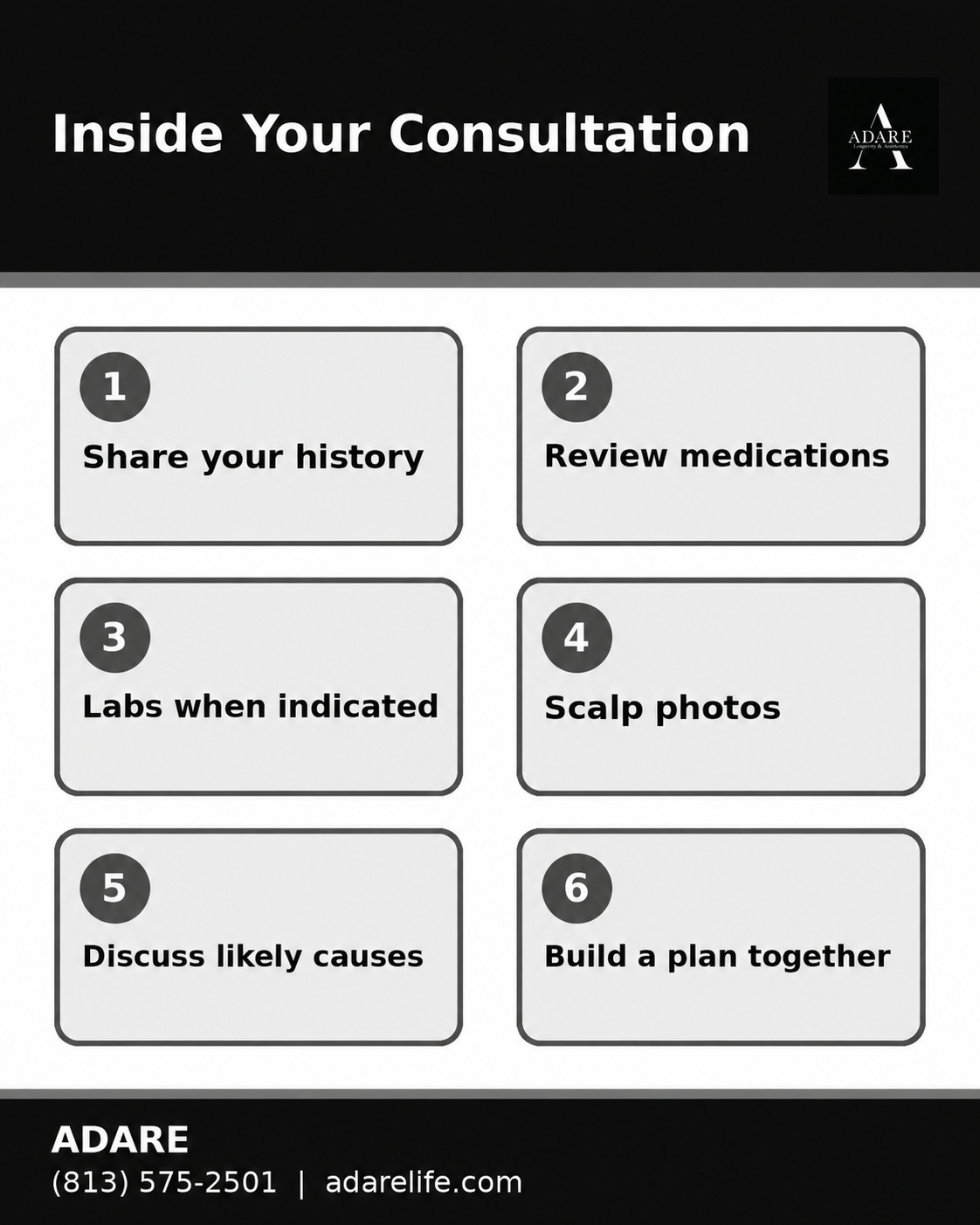
Inside Your Consultation
Who Tends to Book a Consultation?
We see a wide range of clients, including people with early to moderate thinning, a widening part, or increased shedding. We also see postpartum and perimenopausal women navigating hormonal hair changes, and men with early pattern thinning who want to preserve density. Some clients want a non-surgical starting point before considering a transplant.
If your hair loss is advanced, sudden, or patchy, or comes with scalp pain, redness, or scaling, tell your provider. Some causes of hair loss need evaluation by a dermatologist or another physician.
How Should You Prepare?
A little preparation makes the visit more useful:
- Write down when you first noticed changes.
- Bring a list of medications and supplements.
- Bring recent lab results if you have them.
- Note any recent life events, illness, or weight changes.
- Come with your questions written down.
Some clients also bring older photos so the provider can see how their hair looked before.
What Questions Should You Ask?
Good questions to bring to your hair restoration consultation include: What do you think is causing my thinning? Do I need labs? What are my options, and what are the risks of each? How will we track progress? How long before we know whether a plan is helping?
Your provider should answer clearly and never pressure you. At ADARE, every protocol begins with listening, with no pressure and no upsell.
How Does Follow-Up Work?
If you start a plan, your provider will set a follow-up schedule. Photos and notes are compared at each visit, and the plan is adjusted as needed. Hair grows slowly, so patience is part of the process. Our post on hair restoration explains more about what the process can look like.
Is Hair Restoration Only for Women or Only for Men?
Neither. Thinning affects both. You can read about our approach on the hair restoration service page and our hair restoration for men page.
A Few Simple Tips
Do not panic if you shed a bit. Some shedding each day is normal. Track it for a few weeks. Take photos in the same light.
Be gentle with your hair. Skip tight styles. Use less heat when you can.
Ask for help early. It is easier to plan when we start sooner.
Book Your Consultation
A hair restoration consultation is a chance to understand what is happening and what your options are. Call South Tampa at (813) 575-2501 or Downtown St. Pete at (727) 306-0922, or contact ADARE to schedule.
Frequently Asked Questions
- How long is a hair restoration consultation?
- Timing varies. Your provider takes time to review your history, examine your scalp and discuss options.
- Will I need bloodwork?
- Only when your history suggests it. Your provider will explain why any test is recommended.
- Can hormones play a role in hair thinning?
- They can. Hormonal changes are one of several possible factors your provider may look at.
- Does ADARE accept insurance?
- ADARE does not bill insurance. HSA and FSA payments are accepted for eligible services, and superbills are available on request.
- Where are ADARE's studios?
- South Tampa at 3830 West Neptune Street and Downtown St. Petersburg at 125 2nd Ave N, Suite C103.
This article is for general education and is not medical advice. Treatment decisions should be made with a licensed provider after an evaluation. Individual results vary.