Your First Medical Weight Loss Visit: What Gets Checked

If you've tried to lose weight on your own and felt stuck, you're not alone. Weight is rarely about willpower. It's connected to insulin sensitivity, hormones, sleep, stress, gut health, and inflammation. That's why ADARE Longevity & Aesthetics treats weight as a metabolic concern with measurable inputs. If you're thinking about booking a medical weight loss consultation at our South Tampa or St. Petersburg studio, here's what your first visit usually covers.
Why Start With a Medical Evaluation?

A medical evaluation helps your provider understand your health before recommending anything. The National Institute of Diabetes and Digestive and Kidney Diseases explains that treatment for overweight and obesity can include healthy eating, physical activity, behavior changes, and, for some people, medications or other medical approaches. Which ones make sense depends on the person.
A careful first visit makes that decision safer and more personal.
What Does Your Provider Review?
The intake is unhurried. Expect to talk about:
- Your medical history and current health conditions
- Medications and supplements you take
- Your weight history, including what you've tried before
- Your goals and what success looks like to you
- Barriers like sleep, stress, schedule, or cravings
Be as open as you can. These details shape a plan that fits your life.
Which Labs May Be Ordered?
At ADARE, the first visit usually includes having comprehensive labs ordered and drawn on site. These can include metabolic, hormonal, and inflammatory markers. Labs help your provider see what's happening inside your body and whether any factors may be making weight loss harder. Your provider will explain why each test is ordered and review the results with you.
Will You Get a Body Composition Scan?
Often, yes. A scale shows total weight, but it doesn't show what that weight is made of. Our InBody scan measures muscle mass, body fat, visceral fat, and body water. Tracking these numbers over time helps confirm that you're losing fat while protecting muscle.
What Happens After Your Labs Return?
Once your results are in, your provider reviews them with you and talks through options. For some clients, a plan may include prescription medication, such as a GLP-1 receptor agonist. Medication is never automatic. It depends on your health history, labs, and goals, and it isn't right for everyone.
If medication is part of your plan, your provider will explain how it works, possible side effects, and what to expect week to week. Nutrition and movement guidance are part of the plan from the start.
Who May Not Be a Candidate for Certain Medications?
Some people should not use certain weight-loss medications. This can include people with a personal or family history of medullary thyroid carcinoma or MEN2, people who are pregnant or breastfeeding, and people with certain digestive or gallbladder conditions. Your provider will review your history carefully and discuss safer options when needed.
| Part of the visit | What it covers | Why it matters |
|---|---|---|
| Intake | History, medications, goals | Builds a full picture |
| Labs | Metabolic, hormonal, inflammatory markers | Finds factors that affect weight |
| Body composition | Muscle, fat, water | Tracks the right kind of change |
| Results review | Labs and options | Supports an informed choice |
| Plan | Monitored next steps | Keeps progress safe and steady |
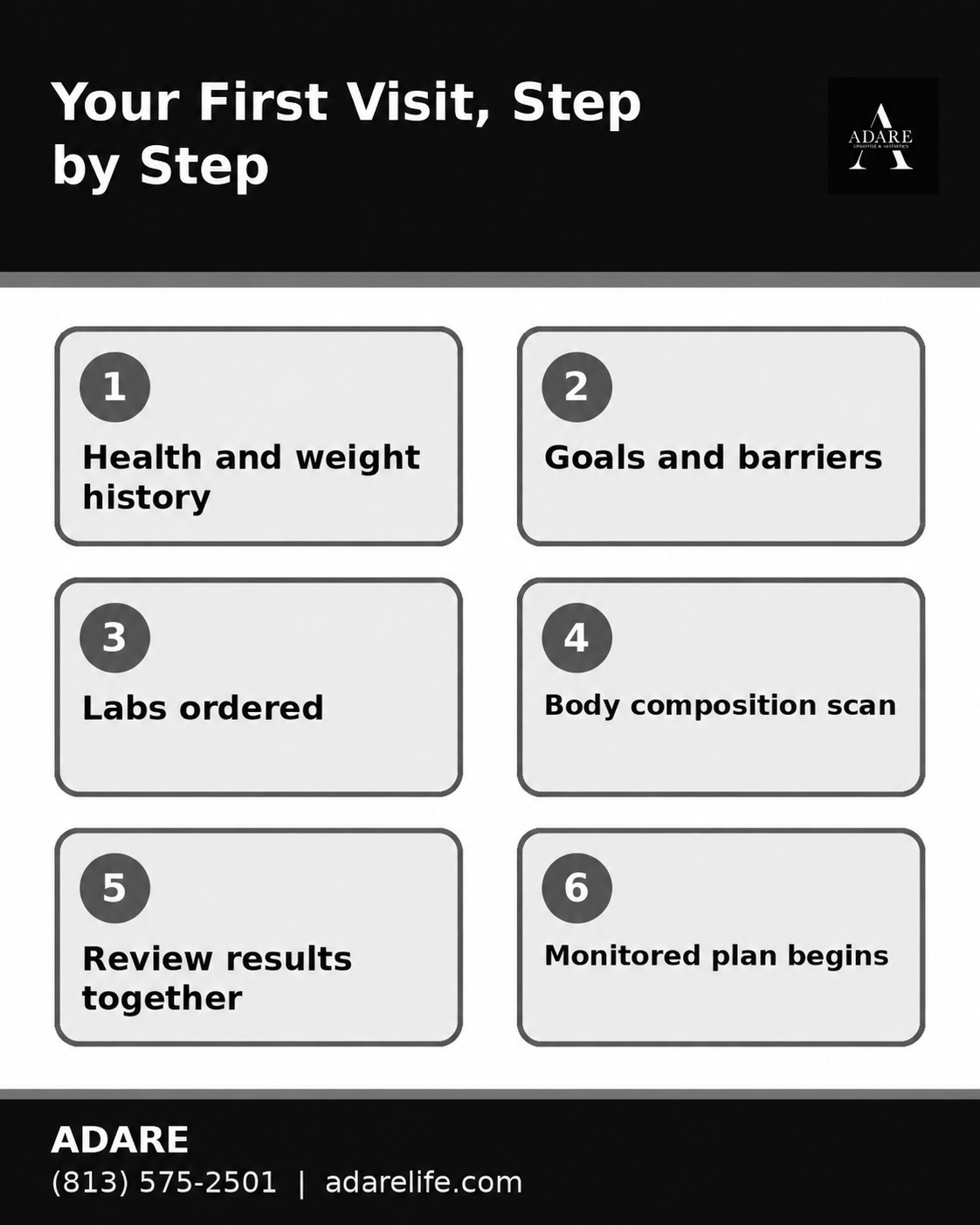
Your First Visit, Step by Step
How Is Progress Monitored?
A medical program is not a prescription and a goodbye. At ADARE Longevity & Aesthetics, your provider checks in regularly, adjusts the plan to manage side effects, and reassesses labs along the way. The goal is steady, sustainable progress, along with a plan for what happens after the program ends.
Results vary from person to person. Your provider will set realistic expectations based on your health and goals.
How Should You Prepare for a Medical Weight Loss Consultation?
Bring a list of your medications and supplements, any recent lab results, and notes on past weight-loss attempts. Think about your goals beyond the scale, such as energy, sleep, or joint comfort. Write down your questions so you don't forget them.
What Questions Should You Ask?
Helpful questions include: What might be making weight loss hard for me? Which labs do I need? Am I a candidate for medication? What side effects should I watch for? How will we protect muscle? What happens when I reach my goal?
Does ADARE Accept Insurance?
ADARE does not bill insurance. HSA and FSA funds are accepted where eligible under your plan, and superbills are available on request. Learn more on our medical weight loss page, or read about body contouring after weight loss.
A Few Simple Tips for Your First Visit
Come as you are. You do not need to diet first. You do not need to look a certain way.
Be honest about your habits. Tell us what you eat on a busy day. Tell us how you sleep. Tell us what has worked and what has not.
Bring a friend if it helps. Take notes. Ask us to slow down if you need to.
Think about what you want most. Is it more energy? Better sleep? Less joint pain? Your goals help shape the plan.
Book Your Visit
A medical weight loss consultation is the first step toward a plan built around your body. Call South Tampa at (813) 575-2501 or Downtown St. Pete at (727) 306-0922, or contact ADARE to schedule.
Frequently Asked Questions
- What happens at a medical weight loss consultation?
- Your provider reviews your history and goals, orders labs when appropriate, and may do a body composition scan.
- Will I get medication at my first visit?
- Not usually. Labs are typically reviewed first, and medication is only considered if it's appropriate for you.
- Is medical weight loss right for everyone?
- No. Your provider will review your health history to decide what's safe and appropriate.
- How is progress tracked?
- Through regular check-ins, lab reassessments, and body composition scans.
- Where are ADARE's studios?
- South Tampa at 3830 West Neptune Street and Downtown St. Petersburg at 125 2nd Ave N, Suite C103.
This article is for general education and is not medical advice. Treatment decisions should be made with a licensed provider after an evaluation. Individual results vary.